Source: YouTube Shorts
You finish a hard interval ride expecting a higher ketone reading—and the number actually drops. Did the workout cancel my ketosis? Should I have stayed easy? Is the meter wrong?
Probably none of those. Hard cardio and easy cardio do not affect blood ketones in the same way, and the post-workout window often tells a different story than the workout itself. The short answer: ketones do not simply "go up" with effort. Intensity changes how fast your body uses ketones, and the rebound after exercise is where many people see the biggest move. Below is what the research shows, and how to read your own trend instead of one number.
The Comparison Frame: Intensity Changes the Question
"Does cardio boost ketones?" is really two questions stacked together: what happens during the workout, and what happens after it. Intensity, duration, fed/fasted state, and prior diet all push the answer in different directions. A position stand from the International Society of Sports Nutrition notes that exercise "may also reduce carbohydrate availability and stimulate ketogenesis depending on its duration and intensity"—the conditional wording is the point.[3] So the more useful framing is not "high intensity vs. low intensity, which wins," but "different intensities, different ketone behavior, different reasons."
Three Mechanisms That Explain What You See on the Sensor
1) During hard cardio, muscles can clear ketones faster than the liver makes them
This is the part that surprises most people. Working muscle is happy to oxidize beta-hydroxybutyrate (BHB) as fuel, and the harder you go, the faster it pulls BHB out of circulation. In a controlled study summarized by Evans and colleagues, 45 minutes of cycling at 75% of maximum work rate produced blood BHB about 3 mmol/L lower than ketosis at rest, while the same duration at 40% produced a smaller drop—evidence of intensity-dependent disposal of BHB during exercise.[1] A real-time sensor watching this can show ketones dipping mid-workout even though you are firmly in fat-burning mode.
2) Above roughly 70% VO2max, the body leans more on glycolysis
At higher intensities, energy demand outpaces what fat oxidation alone can supply, and muscle shifts toward glucose-based pathways. A 2023 review of ketogenic diets and aerobic exercise notes that exercise economy on a high-fat, low-carb diet is most affected at high intensities (above ~70% VO2max), while it tends to be preserved at lower intensities (below ~60% VO2max).[2] This explains why some keto-adapted athletes feel strong on long Zone 2 work but flat on hard intervals: the substrate mix the body actually wants for short, high-power efforts is not the one a ketogenic diet emphasizes.
3) After exercise, ketones often rise—the "post-exercise ketosis" effect
The picture changes when the workout ends. Free fatty acids stay elevated, glycogen has been drawn down, and the liver continues producing ketones into recovery. Evans and colleagues describe this pattern: blood ketones rise gradually during prolonged exercise, then a post-exercise ketosis of roughly 0.3 to 2.0 mmol/L can persist for several hours afterward.[1] A clinical study reported a significant BHB increase 60 minutes after a single exercise session compared with the pre-exercise baseline.[6] So if you check ketones only mid-workout you may see the dip; if you check 30 to 90 minutes later you may see the rebound.
What This Means in Practice (Not Just Theory)
For most everyday keto users, the takeaways are practical, not mystical:
- A mid-workout dip is not failure. It often reflects muscles using BHB faster, not your body abandoning fat metabolism.
- Steady, low-to-moderate cardio is friendlier to a stable ketone reading than all-out intervals, because muscle BHB clearance scales with intensity.[1]
- The post-workout window is where the "boost" usually shows up. Recovery-window readings, not peak-effort readings, are the more honest signal of what exercise did to your fat-burning state.[1][6]
- Performance and ketone level are different goals. Hard intervals on keto can still be useful for fitness; they are just not the right tool to "push my number higher" in the moment.
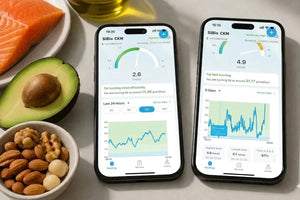
If you watch your trend with Continuous Ketone Monitoring, an intense interval session and an easy 45-minute walk will often look like two different shapes on the curve—even though both are "cardio." Reading the shape, not a single value, is what separates a useful interpretation from a panicked one.
An Action Framework: Match the Workout to the Goal
If your goal is a stable ketone reading on a busy day
Choose 30 to 60 minutes of low-to-moderate cardio—brisk walking, easy cycling, an easy hike. You should be able to hold a conversation. Combined with overnight or morning fasting, this is a setup that consistently supports fat oxidation without large mid-session BHB swings.[2][4]
If your goal is fitness, and you want to keep keto
Mix the week: most sessions easy and steady, a smaller number short and hard. Expect mid-session ketone dips on the hard days; that is the body using ketones, not losing them. Judge the workout by recovery-window readings and how you feel the next day, not by the lowest mid-interval value.[1][3]
If your goal is to see a clearer post-exercise rise
Try fasted or low-carb-fed sessions of moderate duration, then check 30 to 90 minutes after finishing. Research on fasted high-intensity intervals reports more pronounced rises in free fatty acids and BHB compared with fed conditions in some populations.[4] Use this as an experiment, not a daily prescription—fasted hard sessions are not the right default for everyone.
How to Tell the Trend Is Healthy
Single readings can mislead in either direction. A useful trend read on a CKM curve usually shows: a baseline you recognize on your typical eating days, a predictable mid-workout shape during cardio, and a clear return toward (or above) baseline within an hour or two of finishing. If that pattern is intact, your fat-burning system is doing exactly what it should—even when a single number during a hard set looks lower than you expected.
FAQ
Why did my ketones drop in the middle of a hard ride?
The most likely reason is intensity-dependent ketone clearance: muscles burn BHB faster as you work harder, so circulating BHB falls during the effort even though fat oxidation is active.[1]
Should I avoid intense cardio on keto?
Not necessarily. Some keto-adapted people do well with intervals; others feel a bigger drop in performance at high intensity because of substrate limits.[2] Mix easy and hard sessions and judge by overall progress, not a single mid-session number.
When is the best time to check ketones around exercise?
For a "did this workout help?" question, the recovery window—roughly 30 to 90 minutes after finishing—usually tells more than a mid-workout reading.[1][6]
Does fasted cardio raise ketones more than fed cardio?
In some studies, exercise in a fasted state increased BHB more than fed conditions, particularly with high-intensity intervals.[4] Whether that is appropriate for you depends on health status, training goals, and tolerance.
Are ketone supplements a shortcut?
Exogenous ketone salts can raise BHB and fat oxidation during steady-state exercise, but research has shown they may impair high-intensity performance compared with control conditions.[5] They are a tool with trade-offs, not a universal "go faster" pill.
Final Takeaway
Intense cardio does not simply "boost ketones." During the effort, harder cardio often pulls more BHB out of circulation; after the effort, ketones tend to rise during recovery. Both can be true on the same workout. The right way to read your sensor is by trend shape across the full session and the hour or two after, not by a single peak or dip. Match the workout to the goal, watch the recovery window, and let pattern—not panic—guide your next session.
References
- Evans M, Cogan KE, Egan B. (2017). Metabolism of ketone bodies during exercise and training: physiological basis for exogenous supplementation. The Journal of Physiology, 595(9), 2857–2871. https://pmc.ncbi.nlm.nih.gov/articles/PMC5407977/
- Margolis LM, Pasiakos SM, Howard EE. (2023). High-fat ketogenic diets and ketone monoester supplements differentially affect substrate metabolism during aerobic exercise. American Journal of Physiology – Cell Physiology, 325(4), C1144–C1153. https://pmc.ncbi.nlm.nih.gov/articles/PMC10635661/
- Leaf A, Rothschild JA, Sharpe TM, et al. (2024). International society of sports nutrition position stand: ketogenic diets. Journal of the International Society of Sports Nutrition, 21(1), 2368167. https://pmc.ncbi.nlm.nih.gov/articles/PMC11212571/
- Kim S, Park DH, Lee SH, Kwak HB, Kang JH. (2023). Contribution of high-intensity interval exercise in the fasted state to fat browning: potential roles of lactate and beta-hydroxybutyrate. Medicine & Science in Sports & Exercise, 55(7), 1160–1171. https://pmc.ncbi.nlm.nih.gov/articles/PMC10242519/
- O'Malley T, Myette-Cote E, Durrer C, Little JP. (2017). Nutritional ketone salts increase fat oxidation but impair high-intensity exercise performance in healthy adult males. Applied Physiology, Nutrition, and Metabolism, 42(10), 1031–1035. https://pubmed.ncbi.nlm.nih.gov/28750585/
- Matoulek M, Svobodova S, Vetrovska R, Stranska Z, Svacina S. (2014). Post-exercise changes of beta hydroxybutyrate as a predictor of weight changes. Physiological Research, 63(Suppl 2), S321–S325. https://pubmed.ncbi.nlm.nih.gov/24908238/
Disclaimer
This article is for educational purposes only and does not replace professional medical advice, diagnosis, or treatment. Always seek the advice of your physician or another qualified health provider with any questions you may have regarding a medical condition or before starting a new exercise routine.
Author Information
This article was written by the SiBio Professional Health Content Team, focused on evidence-based metabolic health and keto education content.
Last Updated: May 6, 2026